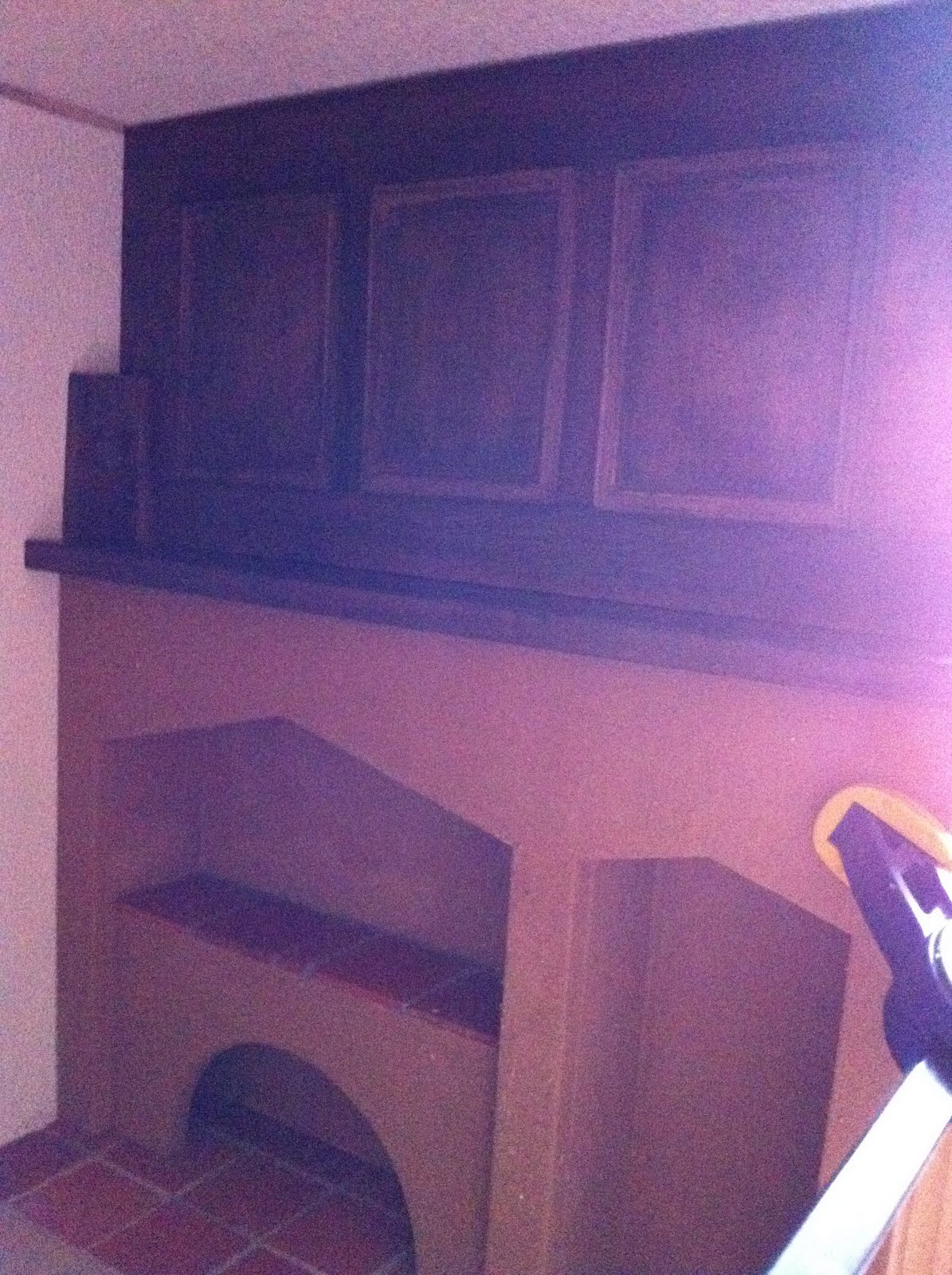
Preparing for the overhaul...
Showing posts with label oops. Show all posts

Saturday, September 8, 2012

What I've Learned From My Mistakes

Don't spray paint in the rain.  Or in the almost-rain.  Or in 99% humidity.  Your metallics will be dull and blotchy, your stoves will fog over.  Although, as we've seen, sometimes mistakes are a blessing in disguise.  In fact, I'm pretty sure this is true in almost every area of life...


The same day I did the blue cook stove, I also sprayed some copper pots.  Which, well, came out looking like something one of my neighbors might dig up out of his root cellar and sell the tourists as an "antique."  So with a little creative craft paint ("Americana" brand craft paint in burnt sienna and lamp black), I went with the "old and gross" theme.

USE MULTIPLE FINE COATS!!!  I thought I already knew this advice.  I mean, duh.  Most of us have been at this for years, and "fine coats" seems like really Mickey Mouse advice.  DO NOT BE FOOLED.  When it comes to spray enamels, flat colors are very forgiving.  Gloss colors are not.  And, I've discovered, the lighter the color, the worse the coverage.  My first few tries with the Testors light ivory were disasters; my paint came out gloppy, or obscured the detail.  I couldn't figure out what I was doing wrong.  Then, after wasting about 20 bucks worth of paint, talking it over with some of my hobbyist friends, and visiting a hobby forum, I learned the following rules:
  1.  Shake the can for at least 5 minutes.  I'm not kidding.  Shake that baby like there's no tomorrow, then shake it some more.  And start with a new can.  If you've got a can that's, like, half gone and you haven't been mixing things up, well, um, it won't ever mix properly.
  2. MIST COATS, dude.  This shouldn't take you two coats, it should take you more like ten.  The finer and more frequent the coats, the happier you'll be with the results.
  3. DO NOT SPRAY ON HUMID DAYS.
Face it, sometimes you just need to use spray paint.  Like, take the pot belly stove, for example.  The sprayed-on enamel more closely resembles enameled cast iron, so you're going to get a better result.  Comparing these two pot belly stoves, I think the ivory one looks a lot more realistic than the green one.


The hair-thin black edges and slightly pebbly texture add realism.
Even with a spray coat over it (Testors "glosscote"), it just doesn't look quite as good.
Oh, yeah, and it's counter-intuitive, but glossy varnish looks better than matte varnish.  It also contrasts much more nicely with the flat black.  Or, at least, I think so.

If you don't want your finish to look pebbly, well, there's a sanding sponge for that and I'll talk about it (if anyone's interested) when I do the parlor stove.  Also known as The Kit From Hell, but that's another story.  Anyway, moving on...

Speaking of which, some mistakes are liberating but some are just depressing.  If it's become a stone around your neck, don't be demoralized; throw it out.  I've thrown out quite a few kits, but I can't really say my money or time was wasted.  I learned a lot.  If every project you try comes out perfect, then you're not stretching yourself and you'll never get better.  Don't be afraid to waste materials, screw up, and look like an idiot.  Within reason, of course; I don't think this stove would make much of a hat.  Or work well as underpants.

Think outside the box, color-wise.  This is your house, do what you want with it.  Just because the folks at Dee's Delights who now produce Chrysnbon made it out of black polystyrene, doesn't mean it has to be black.  Back in the day, people were, I think, a lot more creative with color.  Some of this had to do with the fact that, sans electric light, duller colors were really just lost.  The reason why all that wallpaper was virulently red, black, etc was so it'd show up in gaslight.  And people weren't afraid to go all out, either.  Why can't your pot belly stove be purple?  I've seen antique examples that were aqua, blue, every color under the rainbow.  And even if nobody ever painted it that color before, who cares?

Sometimes gluing two already-painted pieces together causes an ugly colored blob to ooze out.  You can get rid of it by dipping a small angled brush into thinner, then carefully brushing out the seam.  Quickly brush off any excess thinner, to prevent it from eating the surrounding paint.  Repeat the process until it's all gone--and, if all else fails, remember that you can always sand it out and repaint it if you have to.

Wet sanding is key.

Don't spray paint outside.  Even if you're not near a tree--and I can't tell you how many little tree parts I've found embedded in my projects--you're still not safe.  Dude, a bird pooped on the red cook stove.  Invest in a hood, if you can afford it, otherwise try to spray somewhere that's well-ventilated but at least somewhat covered.

One trick I used, when I had to spray outside, was to, as soon as I finished spraying, immediately put a piece of cardboard over my spray box.  Gloss paints stay tacky a LOT longer than flat paints, so keep this in mind.

Stay organized.  All those little bits and pieces can take over your work area, room, and house really quickly.  My family's really tolerant but, um, still.  In college, one of my roommates painted Warhammer figurines and everyone was always stepping on something.  I got out of the shower, put my foot on the mat and got a spear through the webbing between my toes; he was furious that I'd ruined his guy.  What I wanted to know was, why was it in the bathroom in the first place?

Saturday, August 6, 2011

A Word On Mortar

I had a horrendous experience the other day, with a so-called mortar product.  Previously, I'd always used plain old mortar--you know, for full-sized people.  In fact, my favorite brand has always been plain old Home Depot store brand pre-mixed grout.  I favor "Delorean Gray" as a color.  So-called "dollhouse grout" tends to be too sandy for me.  

However, the house I'm working on now is the nicest thing I've done in awhile, so, as I was preparing to grout the walls, I began to wonder: am I selling myself short, here?  Will plain old store brand grout make my project look less than exciting?  Is there a better product I could be using?

I did a little investigating, and it turns out that Greenleaf stucco powder can also (supposedly) be used to create grout.  I mixed the powder with a little gray paint and--breaking one of my own cardinal rules--slapped some on.  Luckily, I'd begun this miserable experiment on a movable piece.  I spent the next ten minutes running it under the faucet, trying to scrub off the horrible goo with a toothbrush.

First, the stucco powder turned my gray paint blue.  I realize that's not what's supposed to happen, but oh well.  Second, it was like tar.  It absolutely would not release from the bricks--which had been properly sealed, and which I've never had any trouble with before--no matter how hard I scrubbed.  Second, it was shiny!  And I don't mean shiny because it was wet, either.  The surface was all wrong for grout; honestly, it looked and felt like plastic.  Whatever applications this supposed "grout" may have, they're not among the traditional.

So, after letting everything dry--and there are still a few areas on the fireplace I'll need to touch up, most likely after it's installed--I returned to my old standby: real grout.  I must say (and I'll be posting pictures shortly, if anyone's interested) I'm extremely happy with how it's come out.  It seems a shame to muck up something as painstakingly realistic as Richard Stacey bricks with a grout that doesn't pass muster.  Incidentally, Richard Stacey sells their own line of mortar, but I've never tried it.  I actually began using Richard Stacey bricks years ago, after purchasing a packet at a local store.  The carry costs were too high, the store owners had concluded, so they were selling off the last of their stock at a cut rate.  I took it home, made a fireplace, and was overjoyed.

Since, at the time, I was unaware of Richard Stacey's complete line of products--indeed, the only association I had was rather negative.  A teacher of mine, a real wank, possessed the same name.  Having no notion that other types of grout existed--but knowing, from previous experience, that so-called "dollhouse grout" was all awful--I used the regular stuff.  And I was pleased!

So there you have it.  Maybe some of you have had good experiences with this product, in which case I'd like to hear about it.  What sorts of grout do you favor--and why?

Monday, July 18, 2011

Installing the Woodwork

Installing the woodwork in the Tudor Bakery has been extremely frustrating.  Several of the pieces I thought I'd cut perfectly turned out to have been cut wrong--and one piece that I thought was cut wrong, and subsequently re-cut, had actually been cut right.  So I ended up making the same blasted thing three times.

Additionally, I discovered that I'd totally neglected to cut some very important pieces--including the second half of the sales window.  I don't know about you, but I, for one, get totally overwhelmed by too many bits and pieces.  I like to install things bit by bit, so I can keep them straight!  Even with labeling, sometimes it's just too confusing for my little brain to handle.

At the moment, I'm in the process of cutting and re-cutting some new pieces.  Hopefully we'll be able to get this show in the road, soon!  I'm honestly getting a little bored of doing the same thing over and over again.

This is the stove, right before I grouted the tiles.  I had a somewhat difficult time figuring out what to do with this surface, as the tiles I'd originally planned on using weren't a great fit.  I am, however, much happier with this solution than I was with the original.

I think the scale of these tiles is more in keeping with the overall scale of the fireplace, and the room.

Here I am, dry fitting the sales window.

And realizing that I'd only cut half of the shutter.

I started gluing in the pieces, one by one.

I like these little clamps for trim.

The next big phase of this project is finishing the exterior woodwork, so I can clad the surfaces.

Here's one of my little boo boo's.  I realized I'd cut the rebate too large, so instead of cutting a whole new piece, since I'll be antiquing this wood so much anyway, I just cut a little filler piece.  I don't think it'll be visible in the final project.

Here's the fireplace, all grouted and installed.  I daubed on some extra stone along the back, to cover up some grout film I couldn't quite remove.  I'm extremely particular about crisp-looking finishes, and don't like when things look muddy.  Unless, of course, I want them to look muddy...

Next, I installed the (first part of the) mantelpiece.

Here I am making sure everything is squared.

And here's the second part of the mantelpiece.

The woodwork here is darker than the woodwork upstairs, the idea being that, down here, it would've darkened over time from exposure to so much smoke and grease.

And here's when I discovered that I'd cut the crown moulding wrong.

Here, I'm dry fitting the shelves.

They'll look good, I think, when they're finally installed.

This is a challenging corner to work in, because it's so dark.

This is the second, smaller shelf.

The door doesn't have any hardware yet.

And here's where I wondered how the heck I'd forgotten to cut the second half of the shutter?  The bottom part forms the sales area, and the top part forms the awning.  I'm also still contemplating how, exactly, I'll attach everything.  When it comes to (good) dollhouse hardware, the choices are pretty limited.

Painter's tape...so historically accurate!

I am NOT looking forward to finishing all this half timbering.

I think I'm going to be very happy with the way the half timbering on the lower part of the house looks.  I made it slightly wider than the half timbering on the top, which hopefully will give the lower half of the building a sturdy look, as well as contribute to the overall "off kilter" effect I'm going for.

An important consideration, when you're building shelves, etc, is what you're going to hang there.  Here, I'm installing the third and final section of the mantelpiece, which has hooks for pots.  I collect J. Getzan copper pots pans, and wanted a good place to put them.  Many of my pieces, like my ebelskiver pan, would work perfectly in a bakery.

I purchased these lovely pieces from SP Miniatures.

While everything dried, I resumed painting the half timbering.

Gee...now I need to varnish it all.

Thursday, February 3, 2011

The Dreaded Warp--Egads!

It's happened to everyone at some point: horrible, uncontrollable warping.  A little warping is, sadly, not to be avoided.  I live in an old (by American standards) house; I know.  But, sometimes, the warping is so bad that it takes your whole setting out of scale.  Awhile ago, I purchased a number of roombox kits, and finished the insides.  I was just getting into roomboxes, and didn't fully appreciate that I needed to finish the outside first.  Ideally, as with any fine carpentry, you want to build a frame first, attaching virgin wood to virgin wood, and thus stopping the warp in its tracks.  There is, after all, only so much that weights and clamps can do.

I was foolish; I didn't realize.  My husband, who's just left the District Attorney's office (our equivalent of the Crown Prosecutor's office) for private practice, requested a barrister's office roombox.  Now, when I see it fully furnished, I see it occupied by Mr. Toad in a wig.  Perhaps he does not.  In any case, I realized that one of my half-finished, badly warped roomboxes would be just the thing--if only I could fix it.  

Eventually, it'll have a glorious front facade, featuring, naturally, my great love: turned columns.  The overall theme, here, is beaux arts; it justifies the encaustic tiles (a find from Germany), dark wood, and odd furniture I plan to use.  Stay tuned!

First, I added a foot to the box, clamping it firmly in place to try.  That alleviated some of the warp, but not all.  Then, I wetted down the sides (and, most especially the bottom) and clamped and weighted it in place to dry.

That enormously heavy box is our silver casket.

Also included in the pile are my anniversary Lord of the Rings tomes. 


 The drawers are in safekeeping, as one of our cats loves to chew wood.  The moulding is made from walnut and pine; the tile is from Germany.  I really built the roombox around the tile, because I loved it so.  I can't wait to furnish it.

As you can see, we have a heavily stocked bar.  Necessary for this sort of work?  My husband would probably say "yes". 


I may have used every clamp in the house. 

But at last, when everything came off in the morning (I let it dry a solid 24 hours, just to be sure), the warp was GONE!  

Now, on to the facade, and then...decorating the inside.  Any suggestions, inspirations, or insights into that particular area would be greatly appreciated.  While I've worked in several offices, I've never decorated one in miniature.

Sunday, January 9, 2011

Getting Rid Of Quick Grip

If you've ever put down a floor, or attached a wall panel with Quick Grip and then decided you hated it, this post is for you.

Contrary to popular belief, Quick Grip isn't a death sentence--it's just a really, really long removal process.  In my particular case, I'd originally begun this project some years ago, and then life got in the way.  I only returned to it three days ago, after my grandmother died.  When the going gets tough, the tough turn to crafts (and food).  I think I've become a little more ambitious for my minis since then, because one of my first thoughts was, why on earth did I ever install this floor?

Now, in all fairness, I'm not a huge fan of plastic sheets--although I've used them successfully before, in Nonesuch House.  For some reason, no matter how carefully I cut them, no matter how much paint, etc I apply to them, they always look a little Fisher Price-esque to me.  Since pink plastic isn't really the look I'm going for, I prefer to stick with natural materials whenever possible.

My as-yet unnamed wizard's eyrie is meant to be a light, cheerful spot.  This aspect of its character is all the more important, because the interior space is so small.  My first solution was to faux-finish over the sheet.  Within minutes, it looked like...a dark hole.  No, I decided, it had to come out.  

And that's when the pain began.

I'd really done a pretty good job of gluing that baby in--and, as we all know, Quick Grip is permanent.  I pulled out what I could, until I was left with this:

First, I pulled off what I could.  Then, I scraped off what I could.  My secret weapon: RUBBING ALCOHOL.  Yes, really.  Rubbing alcohol breaks down the dried Quick Grip.  I sponged some over, and it soaked into the wood--and seeped under the sheet.  It didn't make removal a snap, exactly, but it made it possible. 

Be prepared to 1) keep adding rubbing alcohol and 2) use a lot of elbow grease.  With every application, I got off maybe another 5".  My husband supplied a paint scraper, which helped quite a bit.

 The eyrie had to come upstairs, where there's more natural light.  Forgive the fisheye; that's just my camera.  Eventually, this will (hopefully) be a cute little hut.

I'll be landscaping this "rock"--some day.  It's not supposed to be a blasted heath forever.  My problem is, I hate architectural/modeling grass, for a variety of reasons. 

Yes, there's electrical tape, although the house isn't electrified--for a variety of reasons.

So don't give up!  You can get this stuff off.  It just takes forever.  But, really, isn't it worth it in the end? If you're going to build a home for your treasured minis, dollhouse bears, or whatever, don't you want it to be as fabulous as it can be?  A lot of dollhouse building is trading gratification now for gratification later.